

[Change Management for HR Leaders - Episode 5 ] Managing Change When the Org Chart Shrinks: Restructuring, Survivors and What Comes Next
Updated: 14 hours ago
Restructuring is not complete when the new org chart is announced. HR leaders need to manage the people side early, including impacted employees, survivors, managers and leaders.

For the first time since 2020, Hong Kong C-suite leaders are now more likely than the broader workforce to expect headcount reductions — 29% anticipate cuts, and only 19% of organisations expect to grow headcount in 2026, the weakest reading in years. [Source: KPMG Hong Kong Employment Outlook 2026] Restructuring isn’t a scenario to plan for someday — for a meaningful share of Hong Kong organisations, it’s already the work.
When an organisation restructures, the visible change is the org chart: teams merge, reporting lines shift, some people leave. But the org chart is only the visible part. The deeper challenge is what happens next — and it’s a major people-side change, not just a workforce or cost decision.
Prosci research shows that projects with excellent change management are 7x more likely to achieve change success. In restructuring, this matters because the business case often depends not only on reducing cost, but on whether the remaining organisation can stabilise and perform effectively after the change.
The Announcement Isn’t the Finish Line
Many restructuring efforts treat the announcement as the main event. From an HR process view, that’s understandable — there are legal considerations and approvals to manage. But from a change management view, the announcement is one moment in a much longer transition.
If employees’ questions about their role, their manager and what’s still unclear aren’t addressed well, they fill the gaps themselves. Rumours grow. Trust drops. Survivors wait instead of moving forward.
Restructuring Sends a Cultural Signal
Restructuring doesn’t only change roles and reporting lines — it sends a cultural signal about how the organisation treats people when decisions are difficult.
Employees will watch:
whether leaders communicate honestly,
whether impacted employees are treated with respect,
whether managers are supported, and
whether decisions align with the organisation’s stated values.
If the process feels unclear, unfair or poorly supported, the cultural impact may last longer than the structural change itself.
This is why HR’s role isn’t only to manage the process. HR also helps protect trust, values and the conditions the future organisation needs to actually work.
Prosci’s research on reorganisation projects points to three recurring recommendations:
1. communicate honestly about impacts as early as feasible,
2. engage leadership and middle managers directly, and
3. use a structured plan with a clearly defined future state.
Do Not Forget the Survivors
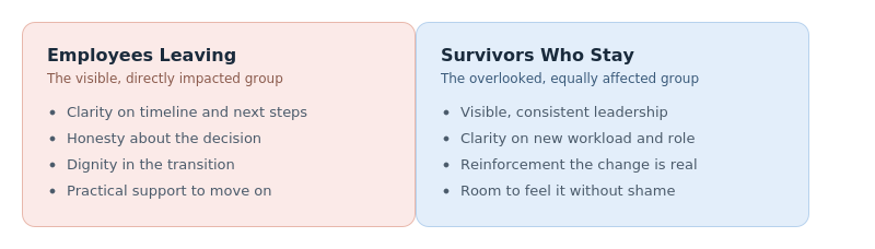
Attention naturally goes to employees whose roles are directly affected. That’s necessary.
But the people who stay experience change too — relief, guilt, anxiety, extra workload, or quietly wondering if another round is coming. These survivor reactions show up as lower engagement, higher turnover among the people you wanted to keep, manager burnout, and “wait and see” behaviour that stalls the new structure from actually taking hold.
The goal isn’t to remove all discomfort — restructuring is rarely easy — but to give people enough clarity and reinforcement to work effectively in what comes next.
Start Earlier Than You Think

In many restructuring efforts, change management begins once decisions are already finalised — often too late. Bringing it into the planning stage, while leaders are still shaping the future organisation, isn’t about slowing the process down. It’s about reducing people risk before the structure is announced rather than after.
Managers carry a lot of this weight:
As the bridge between leadership decisions and employee experience
Need more than a script — clarity on what they can say, help with difficult questions
Coach on supporting survivors specifically
Leaders need to stay visible too: active sponsorship matters most when employees are watching for real signs of commitment.
What to Watch After
The period after restructuring is where the organisation discovers whether the new structure actually works — watch voluntary turnover among key talent, manager stress, engagement dips, and repeated questions about roles and decision rights. These signals show whether things are stabilising or whether deeper risk remains, and they’re where HR’s role shifts from process owner to change enabler: bringing change thinking into planning earlier, equipping managers, and connecting the restructuring decision to what people are actually experiencing.
Setting Up the Series
This is the fifth post in our seven-part series. Next: measuring change ROI, including the survivor signals this post just covered.
If headcount or restructuring decisions are already being discussed at your organization but the people plan hasn’t started yet, that gap is the highest-risk window in the whole process. Our Hong Kong team can help you build the people plan alongside the structural one — before the announcement, not after it.

Author: Catherine Tam Thillainathan
"We guide individual CHANGE from data to impact." Passionate about data and science, Catherine connects practitioners to turn vision and insights into action. A Prosci Advanced Instructor, Principal Advisor of ChangeAccomplishment, Cofounder of Master Change Circle, a lifelong learner, and a volunteer, she fosters peer collaboration and stays grounded in what matters—driving real results for the community.
[Change Management for HR Leaders | Article 5 of 8]


![[Change Management for HR Leaders - Episode 6 ] Measuring Change ROI: Connecting HR Metrics to Change Management Outcomes](https://static.wixstatic.com/media/4d0b38_a55a1f6e803d4251bd0f0a594ad443b4~mv2.jpg/v1/fill/w_980,h_654,al_c,q_85,usm_0.66_1.00_0.01,enc_avif,quality_auto/4d0b38_a55a1f6e803d4251bd0f0a594ad443b4~mv2.jpg)
Comments